
Choosing the right professional water test kit is not as simple as comparing prices or counting included reagents. A reliable kit must match the water source, testing purpose, and required accuracy. Drinking water, private wells, pools, aquariums, and industrial systems can demand very different measurements. Some kits focus on pH, chlorine, hardness, and nitrate. Others test metals, bacteria indicators, turbidity, or conductivity. The best choice begins with the question: what decision will the results support?
This guide examines what are the top 10 professional water test kits by considering accuracy, testing range, ease of use, durability, calibration needs, and evidence behind each method. Experienced technicians usually inspect sample bottles, reagent freshness, detection limits, and storage instructions before testing. Small details matter. A dirty container, warm storage, or delayed analysis can distort results. Digital meters may provide clear readings, yet they still need calibration and careful handling. Color-based tests are practical, but lighting can affect interpretation. No kit is perfect.
We also consider whether manufacturers provide understandable instructions, safety information, technical support, and quality documentation. Results should be recorded with the date, water source, test method, and unusual observations, such as cloudiness or metallic odor. A professional water test kit can support informed decisions, but it should not replace accredited laboratory confirmation when contamination is suspected or results carry serious health consequences. Readers should compare independent evidence, follow applicable local guidance, and question impressive claims without clear validation. That caution is useful.
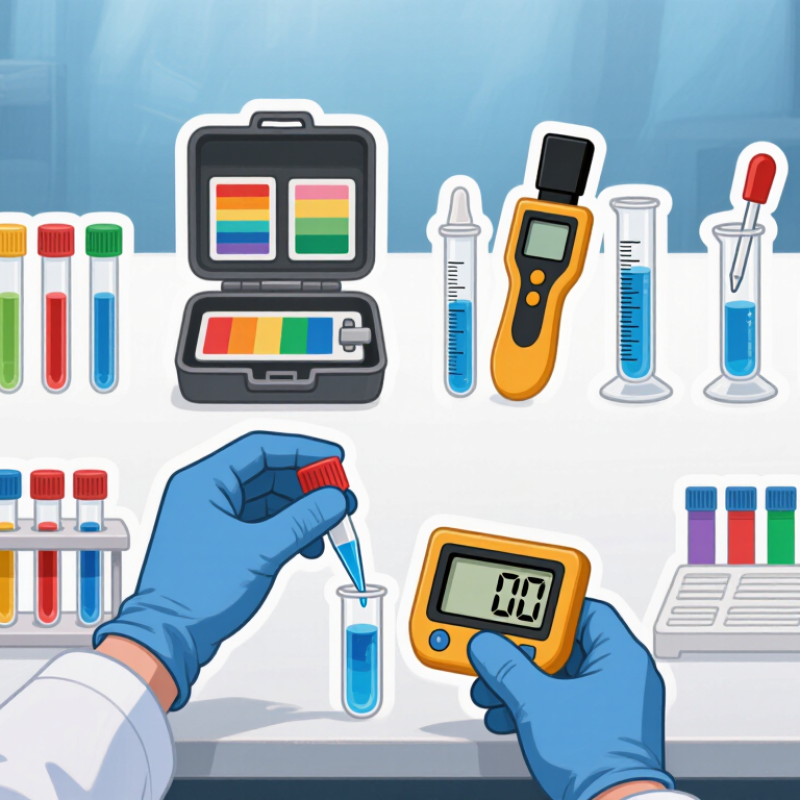
A professional water test kit earns trust through repeatable results, not a crowded case.
In field inspections, I look for clear instructions, sealed reagents, and stable testing procedures. A technician should obtain similar readings from the same sample under similar conditions. That sounds basic. It is often missed.
Reliable kits state detection limits, measurement ranges, and acceptable error margins. They also identify whether results are approximate or suitable for compliance screening.
Good design reduces human mistakes.
Color charts need sharp contrast and consistent lighting guidance. Digital meters should show calibration prompts, battery status, and temperature effects.
Reagents need expiry dates, lot numbers, and storage instructions. A kit stored in a hot vehicle may produce questionable readings, even when unopened.
Before testing, I compare a control solution with its expected value. If it fails, I stop and investigate rather than adjust the result.
Professional credibility also depends on documentation.
Each test record should include the sample location, collection time, water temperature, operator, and method used. Independent laboratory comparisons can reveal bias that routine field checks miss.
Yet no portable kit is perfect. Turbidity, dirty cells, and rushed timing can distort results. I have made that mistake myself.
Repeating the test, preserving the sample correctly, and reporting uncertainty makes the finding more honest. A reliable kit supports judgment; it does not replace trained interpretation.

Professional water test kits should be chosen according to the water source, intended use, and possible contamination risks. For routine screening, test temperature, pH, turbidity, electrical conductivity, and total dissolved solids. These measurements reveal changes in mineral content, acidity, and suspended particles. Temperature matters. It can influence dissolved oxygen and chemical reactions.
Different sources require different chemical tests. Drinking water may need free chlorine, hardness, alkalinity, nitrate, nitrite, ammonia, iron, lead, copper, and other metals. Private wells deserve extra attention because groundwater can carry minerals or agricultural pollutants without visible warning. Surface water often requires dissolved oxygen, phosphate, and microbiological indicators, such as coliform bacteria. Clear water is not necessarily safe water.
Reliable testing depends on technique, not only equipment. Calibrate meters, check expiration dates, collect clean samples, and record the time and location. Duplicates and blank samples can expose handling errors. A field kit provides useful screening, but laboratory confirmation may be necessary for pathogens, trace metals, or disputed results. No kit is perfect. A color change can be difficult to judge under weak lighting, and a precise digital reading can still be wrong after poor calibration. I would question any result that conflicts sharply with the water’s history, smell, or recent environmental changes.
Which Water Quality Parameters Should Be Tested?
Professional water testing commonly includes metals, nutrients, disinfectants, minerals, and general water-quality indicators. This chart compares ten core parameters with U.S. EPA drinking-water reference values. Because the values range from micro-contaminant levels to hundreds of milligrams per liter, a logarithmic scale is used. Regulatory limits may vary by country and by water-use purpose.
Comparing the top 10 professional water test kits starts with the water source and testing purpose. A kit for drinking water may measure lead, nitrate, bacteria, hardness, and chlorine. An industrial kit may focus on metals, conductivity, pH, or dissolved oxygen. Check the detection range carefully. A narrow range can miss heavily contaminated samples. A wide range may reduce sensitivity at low levels.
Look at the testing method, not only the number of parameters. Digital meters offer clearer readings, while color strips are faster but more subjective. Review calibration steps, reagent shelf life, sample volume, and replacement costs. Professional users should also check independent validation and recognized laboratory methods. In my field experience, unclear instructions create more errors than difficult chemistry. No kit is perfect. Even trained users can misread a faint color change.
Tips: Compare detection limits before comparing prices. Choose sealed reagents and readable instructions. Record sample temperature, location, time, and results. Test a known reference sample when possible. Clean equipment between tests. If a result seems unusual, repeat it with a fresh sample instead of trusting one reading.
What Are the Top 10 Professional Water Test Kits?
Professional water testing requires more than a colorful result. A multiparameter photometer measures several indicators with digital accuracy and stored calibration data. A pH and conductivity meter offers temperature compensation, replaceable probes, and fast readings in the field. A dissolved oxygen kit should include a membrane system or optical sensor for aquatic assessments. A turbidity meter needs a sealed sample chamber and controlled light detection. A chlorine kit should separate free chlorine from total chlorine and provide a clear detection range. These features help technicians compare readings across different sampling locations.
A hardness and alkalinity kit uses measured titration, allowing better control than simple color strips. A nitrate and phosphate kit should include low-range reagents for detecting nutrient changes in lakes or wells. A metals screening kit may test iron, copper, lead, or other target elements, but its detection limits must be checked carefully. A microbiological presence-absence kit offers sealed containers and controlled incubation conditions, reducing handling errors. A field colorimetric kit is compact, quick, and useful during inspections, although visual color matching remains subjective. Every professional kit should show expiration dates, calibration instructions, sample volume, and quality-control guidance. I have found that clean glassware matters more than expected. Even experienced users can overlook residue. Field results are valuable, but unusual findings should receive laboratory confirmation.
| Rank | Professional Kit Type | Main Parameters | Typical Test Method | Typical Working Capability | Key Features | Recommended Applications |
|---|---|---|---|---|---|---|
| 1 | Multiparameter Photometric Water Kit | pH, free chlorine, nitrate, nitrite, ammonia, phosphate, iron and hardness | Digital colorimetry with reagent tablets, powders or liquid reagents | Common parameter ranges include pH 6.0–9.0, free chlorine 0–5 mg/L and nitrate 0–50 mg/L, depending on the test program | Broad parameter coverage; digital result display; timed reaction control; replaceable reagent sets; reduced color-matching subjectivity; suitable for routine quality records | Drinking-water screening, facility maintenance, field inspections and general water-quality surveys |
| 2 | Drinking-Water Compliance Screening Kit | Free chlorine, pH, nitrate, nitrite, ammonia, alkalinity, hardness and turbidity | Colorimetric, titrimetric and visual turbidity procedures | Designed for low-to-moderate concentrations commonly encountered in treated and source water | Includes tests relevant to treatment verification; separate low-range procedures; sample collection accessories; clear reaction-time instructions; useful for trend monitoring | Small water systems, building water management, source-water checks and treatment-process verification |
| 3 | Wastewater COD and Nutrient Kit | Chemical oxygen demand, ammonia, nitrate, nitrite, phosphate and pH | Sealed-tube digestion followed by photometry, plus colorimetric tests | COD programs commonly cover approximately 0–1,500 mg/L, with separate low-, medium- and high-range tubes | Digestion capability for oxidizable material; interchangeable range programs; high-range wastewater options; results suitable for process trending; chemical-resistant storage case | Municipal wastewater, industrial effluent, treatment-plant process control and discharge investigations |
| 4 | Metals Screening Water Kit | Lead, copper, iron, manganese, zinc and chromium | Selective colorimetric reactions, sometimes supported by extraction or digestion steps | Low-level screening commonly begins in the µg/L to low mg/L range, depending on the metal and reagent chemistry | Individual metal procedures; contamination-control guidance; blank and verification steps; optional digestion for dissolved or total-metal screening; portable field format | Corrosion investigations, industrial sites, groundwater screening and plumbing-system assessments |
| 5 | Microbiological Water Testing Kit | Total coliforms, Escherichia coli, enterococci and heterotrophic bacteria | Membrane filtration or presence/absence enzyme-substrate testing with incubation | Results are commonly reported as presence/absence or colony-forming units per 100 mL | Sterile sampling materials; defined sample volumes; incubation vessels or trays; positive and negative control guidance; clear interpretation criteria | Drinking-water hygiene checks, recreational water, wells, emergency response and sanitation monitoring |
| 6 | Hardness and Alkalinity Titration Kit | Total hardness, calcium hardness, alkalinity and acidity | Complexometric and acid-base titration using a burette or calibrated drop counter | Hardness is commonly reported as mg/L as CaCO₃; alkalinity procedures often cover approximately 10–500 mg/L as CaCO₃ | Good suitability for repeated process checks; endpoint indicators; standardized titrant volumes; low operating cost; useful for scaling and corrosion evaluations | Boiler systems, cooling towers, water softeners, drinking-water treatment and pool or spa maintenance |
| 7 | Conductivity, TDS and Salinity Kit | Electrical conductivity, total dissolved solids, salinity and temperature | Electrochemical measurement with a conductivity cell and temperature compensation | Typical portable instruments cover from low-conductivity fresh water to brackish or saline water, often up to 100 mS/cm | Fast readings; automatic temperature compensation; calibration standards; selectable units; reusable probe; strong indicator of dissolved ionic changes | Reverse-osmosis monitoring, hydroponics, aquaculture, groundwater surveys and industrial process water |
| 8 | Turbidity and Suspended-Solids Field Kit | Turbidity, visual clarity and approximate suspended solids | Nephelometric measurement or calibrated visual turbidity comparison | Digital nephelometric systems commonly measure from less than 1 NTU to several hundred NTU, depending on the optical design | Portable optical cell; repeatable measurement geometry; calibration standards; light-shielded sample chamber; useful for detecting particles and treatment changes | Drinking-water plants, surface water, construction-site runoff and filtration performance checks |
| 9 | Dissolved Oxygen and Aquaculture Kit | Dissolved oxygen, temperature, pH, ammonia, nitrite and alkalinity | Optical or electrochemical dissolved-oxygen measurement combined with colorimetry and titration | Dissolved oxygen is commonly measured from 0–20 mg/L; nutrient ranges vary by reagent program | Temperature compensation; air or water calibration; oxygen saturation calculation; aquatic-life-oriented nutrient tests; waterproof field components | Fish farms, hatcheries, ponds, aquariums, rivers and biological treatment systems |
| 10 | Chlorine, pH and Disinfection Control Kit | Free chlorine, combined chlorine, total chlorine, pH and cyanuric acid | DPD colorimetry or comparator testing with pH indicator chemistry | Free and total chlorine are commonly measured from 0–5 mg/L, with higher-range options for selected applications | Separates free, combined and total chlorine; rapid reaction times; low-range sensitivity; pH correction capability; compact layout for frequent checks | Disinfection systems, swimming pools, cooling water, food-processing water and healthcare facilities |
Choosing among the top 10 professional water test kits requires more than counting available parameters. Start with your water source and testing purpose. Drinking water, groundwater, pools, and industrial discharge require different analytes and detection ranges. The World Health Organization’s Guidelines for Drinking-water Quality emphasizes risk-based monitoring, not identical testing everywhere. A kit for routine drinking water may measure pH, turbidity, residual disinfectant, nitrate, and microbial indicators. A field kit for groundwater may also need metals, conductivity, and hardness.
Check whether the kit follows recognized methods. The U.S. Environmental Protection Agency’s National Primary Drinking Water Regulations links regulated contaminants with approved analytical procedures. Look for stated detection limits below your action levels. Accuracy matters when a result sits near a regulatory threshold.
Review calibration instructions, reagent stability, sample holding times, and quality-control requirements. A certificate alone is not enough. Ask whether the method fits your sample matrix.
Field conditions expose weaknesses quickly. A bright screen cannot fix expired reagents or a dirty cuvette. Choose sealed components, clear timing steps, and readable results in low light. Digital records help track location, operator, temperature, and sampling time.
The 2023 WHO/UNICEF Joint Monitoring Programme reported that 2.2 billion people lacked safely managed drinking water in 2022, showing why dependable screening matters.
Still, no portable kit replaces accredited laboratory confirmation for serious decisions. I have found convenience persuasive, sometimes too persuasive. Test kits can appear precise while sampling remains inconsistent. Train users, duplicate selected samples, and document every unusual result.