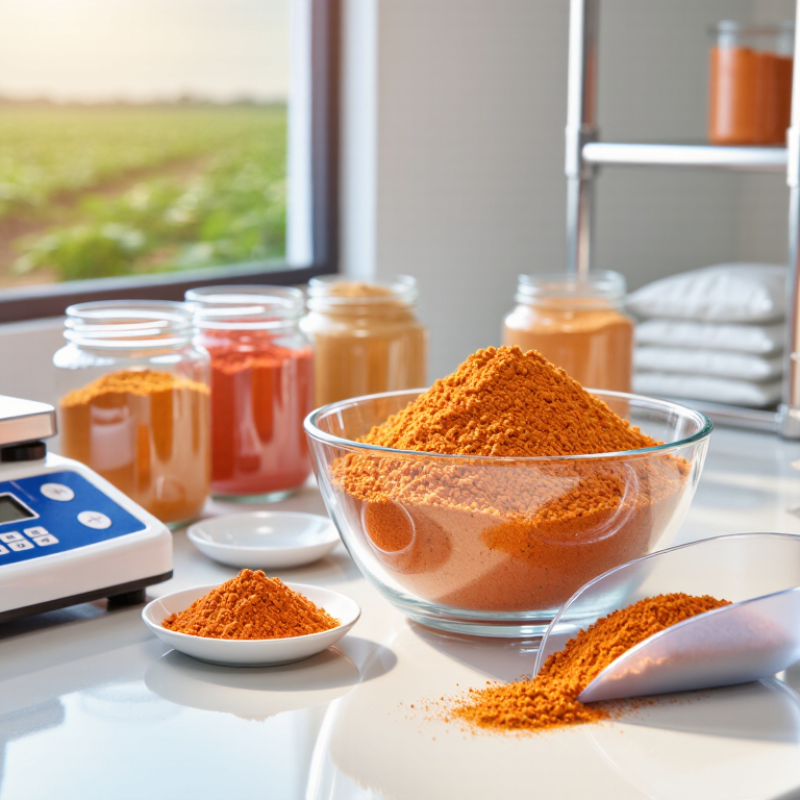
Sourcing Organic Sweet Potato Powder in 2026 requires more than comparing supplier prices. The real work begins with defining the powder’s intended use, target market, and quality expectations. A bakery may need a fine mesh and mild sweetness. A beverage manufacturer may prioritize solubility, color stability, and low moisture. These details shape every purchasing decision.
Experienced buyers should request current organic certificates, product specifications, allergen statements, and certificates of analysis. Check the certifier’s validity independently. Organic requirements can differ between the United States, European Union, and other markets. Do not assume one certificate covers every destination. Testing should include pesticide residues, heavy metals, microbiological safety, moisture, and identity. Traceability also matters. Ask where the sweet potatoes were grown, when they were processed, and how batches are separated. A supplier who cannot answer clearly may create avoidable risks.
Small details matter.
Packaging deserves attention too. Multi-layer bags, sealed liners, and dry storage can protect powder quality during shipping. Request a production sample before placing a large order. Compare its aroma, color, texture, and performance in your actual formula. A bright orange sample may still perform poorly after heating. That is easy to miss. Pricing should include testing, freight, customs, storage, and possible rejected batches. Supplier audits, video inspections, or third-party verification can strengthen confidence, although none is perfect. Even experienced sourcing teams sometimes overlook seasonal variation or inconsistent particle size. Leave room for questioning. Reliable sourcing is not about finding the cheapest Organic Sweet Potato Powder; it is about building evidence that supports safe, consistent, and commercially practical supply.
Organic sweet potato powder is dehydrated, milled sweet potato flesh. It is not sweet potato starch. The powder should retain a natural orange color, mild sweetness, and recognizable root aroma. FAOSTAT reports global sweet potato production above 85 million tonnes annually, supporting broad raw-material availability. However, supply volume does not guarantee organic integrity.
A 2026 purchasing specification should require valid organic certification for farming, processing, and handling. The applicable standard may follow USDA organic rules or European organic legislation. Each shipment should include traceability records and an organic transaction certificate. Moisture below 8% is a practical target. Water activity below 0.40 can reduce caking and microbial growth. Particle size should match the application, such as 80–100 mesh for beverages and bakery premixes.
Microbiological testing should cover total plate count, yeast, mold, Salmonella, and pathogenic Escherichia coli. Buyers should also request pesticide-residue, heavy-metal, and mycotoxin analysis. Organic does not mean residue-free. That distinction is often missed. Packaging should use sealed, food-grade, moisture-resistant bags with lot codes and production dates. The Organic Trade Association’s 2024 Organic Industry Survey valued United States organic sales at 69.7 billion dollars in 2023, showing continued demand for verified ingredients. Still, color and sweetness can vary between harvests. A fixed specification may need seasonal review.
How to Source Organic Sweet Potato Powder in 2026?
Sourcing organic sweet potato powder in 2026 starts with label architecture, not a supplier brochure. Under USDA organic rules, “organic” products need at least 95% certified organic agricultural ingredients. Salt and water are excluded. Remaining ingredients must appear on the National List of Allowed and Prohibited Substances. EU Regulation 2018/848 also uses a 95% agricultural-ingredient threshold. However, its permitted substances and documentation requirements differ. Small wording matters.
The FiBL and IFOAM World of Organic Agriculture 2024 report recorded global organic retail sales of €134.8 billion in 2022. Rising demand increases verification pressure. Request a current certificate covering sweet potato processing, not only cultivation. Check the operator name, certificate scope, validity, identification number, and processing address. Ask for lot-specific reports covering pesticide residues, moisture, microbes, and heavy metals. Compare the lot number on the bag, certificate, invoice, and certificate of analysis. It sounds basic. It prevents expensive surprises.
For USDA sales, verify every carrier, anti-caking agent, and flavoring against the National List. For EU sales, confirm the control-body code, farming-origin statement, and organic percentage calculation. Keep transaction records, supplier declarations, formulation sheets, and mass-balance evidence. “95% organic” is not automatically equivalent across markets. A frequent weakness is inconsistent percentage calculation. Recalculate using the finished formula. Then test a retained sample. Paperwork can be incomplete.
| Verification Dimension | USDA Organic Requirement | EU Organic Requirement | Buyer Verification Data and Documents |
|---|---|---|---|
| Applicable legal framework | National Organic Program requirements under 7 CFR Part 205. The Strengthening Organic Enforcement amendments became effective on March 19, 2024. | Regulation (EU) 2018/848 and related implementing regulations. The current EU organic framework has applied since January 1, 2022. | Record the applicable standard, certification scope, certification status, and the date on which each document was issued. |
| 95% ingredient rule | Required A processed product must contain at least 95% organic ingredients, excluding added water and salt, to use the term “organic” in the principal product name. | Required At least 95% of the agricultural ingredients must be organic to identify the product as organic in the sales name. | Obtain the complete formula, ingredient percentages, and calculation method. Confirm that water and salt are excluded only where the applicable rule permits. |
| Sweet potato as the main ingredient | The sweet potato must be certified organic if the finished powder is sold as an organic product. The ingredient must be covered by the certifier’s approved organic handling scope. | The sweet potato must be certified organic and traceable to an operator covered by an EU-recognized control system. | Verify the organic certificate, product list, certified facility address, crop or processing scope, and the exact product description “organic sweet potato powder.” |
| Products below 95% organic content | Products containing at least 70% organic ingredients may use “made with organic” followed by specified ingredients, but may not use the USDA Organic seal or present the whole product as organic. | Products below the 95% threshold cannot use the EU organic logo or present the product as organic in the sales name. Organic ingredients may be identified in the ingredient list under applicable conditions. | Reject any specification that uses an unrestricted “organic” product claim while the calculated organic agricultural ingredient percentage is below 95%. |
| Certification body or control authority | Certification must be issued by a USDA-accredited certifying agent for operations within the relevant certification scope. | Certification must be issued by an authorized control body or control authority recognized for the applicable EU organic scope. | Check the certificate number, legal operator name, certified activities, validity period, scope, and issuing organization. Verify the certificate directly through the issuing organization where possible. |
| Organic certificate validity | Organic operations are subject to certification, annual inspection, and ongoing compliance review. A certificate should be current at the time of purchase and shipment. | Organic operators are subject to control procedures and regular verification. The certificate must be valid for the operator and activity involved in the transaction. | Require a current certificate before purchase order approval, and recheck it before shipment if the certificate is close to expiry or the supplier has changed facilities. |
| Traceability and transaction records | Certified operations must maintain records that demonstrate traceability from receiving through processing, storage, and shipment. | Operators must maintain records supporting traceability, organic status, supplier identity, quantities, and product movements. | Request lot number, harvest or production date, raw-material lot, processing date, quantity received, quantity produced, warehouse location, and shipping documents. |
| Mass-balance check | Organic input quantities should reasonably reconcile with production output, processing loss, inventory, and sales records. | Organic input and output records should support product integrity and prevent substitution or commingling. | Compare raw sweet potato input, drying yield, milling yield, finished powder output, inventory, and shipment quantity for the selected lot. |
| Processing aids and additives | Non-agricultural ingredients and processing aids must comply with the applicable permitted-substance requirements. The use of an ingredient is not automatically allowed merely because it is natural. | Additives, processing aids, and other non-agricultural substances must be permitted under the EU organic rules and used only under the applicable conditions. | Obtain the full processing flow, additive declaration, processing-aid declaration, and written confirmation that no prohibited bleaching, anti-caking, color, or synthetic preservation agent was used. |
| Facility segregation | Organic products must be protected from commingling with non-organic products and from contact with prohibited substances. | Organic and non-organic products must be handled in a way that preserves organic integrity and prevents commingling or contamination. | Review the facility flow chart, cleaning procedure, line-clearance records, storage map, packaging controls, and previous nonconformance records. |
| Import and export documentation | Imported organic products entering the United States must meet USDA organic requirements and may require an electronic import certificate associated with the shipment. | Organic products entering the European Union generally require an electronic certificate of inspection for the relevant consignment, issued through the applicable EU organic control system. | Confirm the destination-market import requirements before shipment. Match the certificate of inspection, commercial invoice, packing list, lot number, quantity, and transport documents. |
| Label and claim review | The organic claim, certifier identification, ingredient statement, and any organic seal must match the product’s certified category and approved label. | Organic labeling must comply with EU presentation rules. When the EU organic logo is used, the control-body code and agricultural-origin statement are required in the prescribed format. | Approve the final artwork only after checking the certified product name, ingredient list, net weight, country-of-origin statement, certifier details, and destination-market claim language. |
| Country-of-origin statement | The country of origin must be stated according to the applicable U.S. labeling and import requirements. Organic status does not replace origin disclosure requirements. | When the EU organic logo is used, the agricultural raw materials statement must identify whether ingredients are from the EU, non-EU, or a combination of EU and non-EU agriculture, as applicable. | Match the origin statement to the actual sweet potato growing location and processing location. Do not use the processing country as the agricultural origin unless it is accurate. |
| Residue and contamination control | Organic certification does not mean that a product is completely free of environmental residues. Prohibited-substance contamination and pesticide-residue findings must be investigated under the applicable compliance procedures. | Organic integrity requires compliance with EU organic production rules and investigation of suspected contamination or non-compliance. | Use a risk-based testing plan covering pesticide residues, heavy metals, microbiological parameters, mycotoxins where relevant, and foreign material. Define acceptance limits before purchasing. |
| Recommended commercial specification | A purchase specification should identify product form, ingredient identity, organic category, packaging, lot coding, storage conditions, and shelf-life requirements. | The same commercial information should be consistent with the organic certificate, technical specification, and EU label approval. | Record powder mesh or particle-size range, moisture limit, microbiological limits, packaging material, storage temperature, shelf life, allergen status, and test methods as contractual requirements. |
| Final approval decision | Pass only if verified Current certification, compliant formula, approved processing, traceability, and shipment documentation must all be available. | Pass only if verified Current control certification, 95% calculation, permitted processing, traceability, labeling, and import documentation must all be consistent. | Approve the supplier only when all mandatory records are complete, the certificate scope covers the exact product, and the lot-level documents reconcile with the purchase order. |

Supplier capacity should mean available monthly output, not an impressive annual figure. Ask for recent production records, drying equipment details, and batch consistency data. A supplier producing 20 tons monthly may not support a sudden 10-ton order. Check whether the stated capacity is shared with other products. It often is. Request a pre-shipment sample, organic certification, certificate of analysis, moisture results, mesh size, and microbiological limits. These documents reveal more than a sales presentation.
MOQ affects both price and inventory risk. Smaller MOQs usually cost more per kilogram, but they reduce cash pressure and waste. Confirm whether the MOQ applies to one flavor, one package size, or a full production run. Lead time should include raw material preparation, drying, testing, packing, and export handling. In 2026, a realistic schedule may range from three to eight weeks. Add extra time during harvest transitions or laboratory backlogs. The cheap quote can mislead.
Price trends will likely reflect sweet potato yields, organic farm premiums, electricity costs, packaging, and freight rates. Compare at least three quotations using the same specifications and delivery terms. Ask how long each price remains valid. A fixed price may look safer, but it can include a hidden risk premium. A flexible quote may be cheaper, yet harder to budget. I would also review two production batches before signing a long contract. One good sample is not proof of stable quality.
How to Source Organic Sweet Potato Powder in 2026?
A reliable supplier should provide lot-specific testing, not a recycled certificate. Check moisture and water activity, because damp powder can cake, darken, or support microbial growth. Set measurable limits in the purchase specification. Audit Salmonella, E. coli, yeast, and mold results using validated methods. The method, detection limit, sample date, and laboratory accreditation should appear on each report. A pass/fail statement is not enough.
Heavy metals require closer attention. Sweet potatoes grow underground and can absorb contaminants from soil. Request lead, cadmium, arsenic, and mercury results, preferably from an ISO/IEC 17025 laboratory. Codex Alimentarius and the Joint FAO/WHO Expert Committee on Food Additives treat lead exposure as a serious public-health concern. Test every production lot, or justify a risk-based frequency with soil history. Also review allergen controls, shared equipment, cleaning records, and an allergen declaration. Pesticide testing should cover the growing region’s risk profile. The European Food Safety Authority’s 2023 monitoring report found about 99% of tested samples complied with legal limits, but compliance does not replace supplier verification.
Tips: Ask for raw chromatograms when results seem unusually perfect. Confirm organic certificates directly with the issuing authority. Check the certificate scope, product name, facility, and expiry date. I would also retain a sealed sample for independent testing. It costs more. Yet one overlooked contaminant can cost far more. Supplier paperwork can look impressive, and still be incomplete.
Audit moisture, microbial, heavy-metal, allergen, and pesticide results before approving a supplier.
Sourcing organic sweet potato powder in 2026 requires more than an organic certificate. A traceable purchase plan should begin at the farm and end with the sealed shipment. Ask suppliers to identify fields, harvest dates, drying sites, and lot numbers. Keep these details in one controlled record.
During supplier approval, review the HACCP plan, not just the certificate. Check hazards such as microbial contamination, pesticide residues, heavy metals, foreign matter, and allergen cross-contact. Organic does not mean hazard-free. A sound HACCP plan should define critical limits, monitoring frequency, and corrective actions.
Each shipment should include a COA that matches the exact production lot. Request results for moisture, microbiological limits, pesticide residues, heavy metals, and product identity. Confirm the sampling date, test methods, laboratory credentials, and specification limits.
Do not accept a generic annual COA. It may look official. It may not describe your shipment. Use independent batch testing before release, especially for new suppliers or changed processing sites. Retain a sealed sample with the purchase records.
Your purchase agreement should require lot traceability, change notification, storage conditions, and clear rejection procedures. On arrival, inspect seals, packaging, odor, color, and powder flow. Record the lot number, not only the pallet number.
I have seen this small mistake weaken an otherwise careful system. A second-person check can help. Still, no plan catches every issue. Seasonal crops may change color or moisture. Review deviations honestly, then adjust testing frequency without lowering safety standards.